
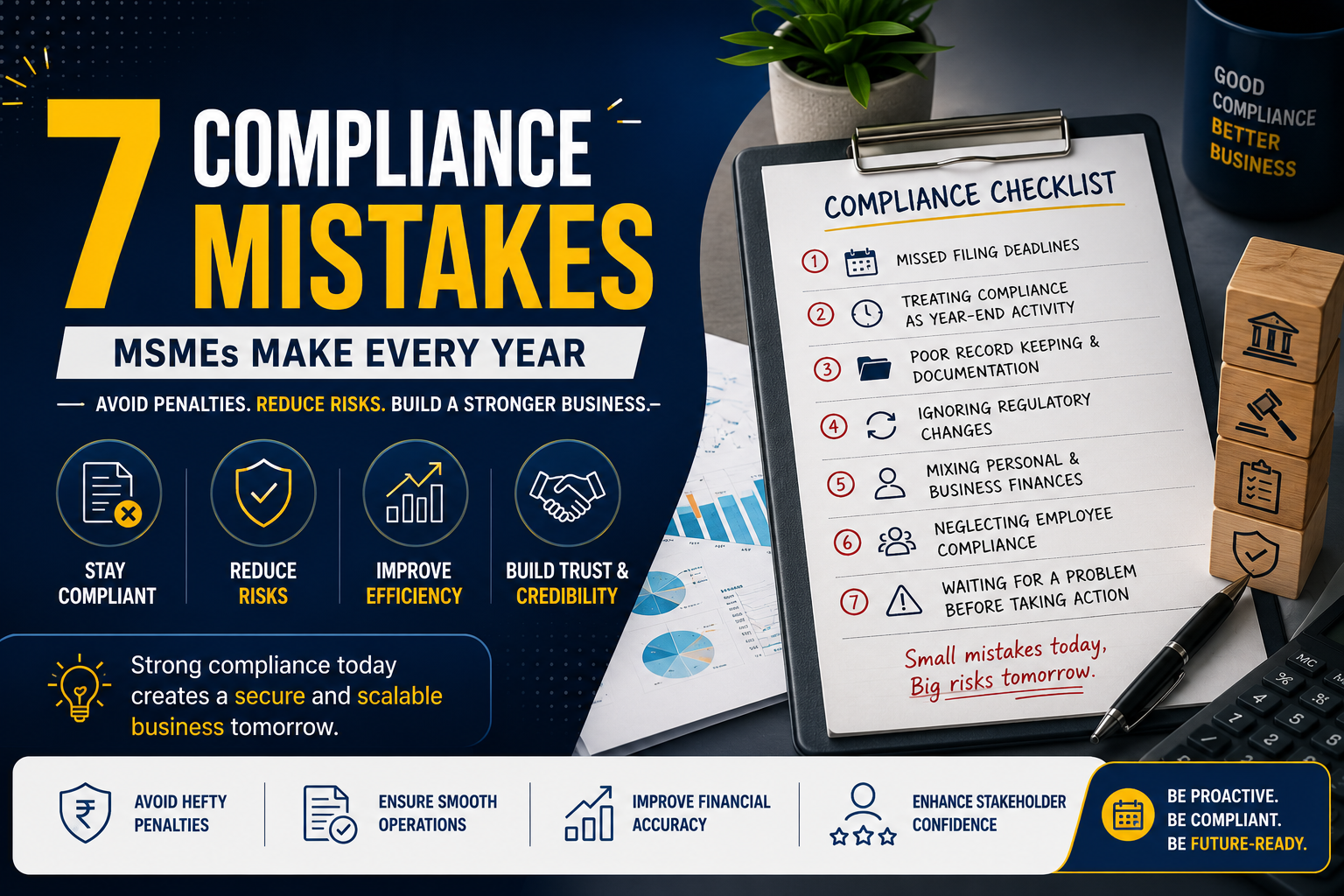
You can have great products, loyal customers, and growing revenues, yet still face serious business challenges because of compliance mistakes.
It happens more often than you might think.
Many MSME owners focus heavily on sales, operations, and customer service while treating compliance as a back-office activity. Unfortunately, regulators do not see it that way. A missed filing, incomplete documentation, or outdated process can lead to penalties, notices, funding delays, and reputational damage.
India is home to more than 6 crore MSMEs, making it one of the largest MSME ecosystems in the world. Yet many businesses continue to struggle with GST compliance, tax filings, employee regulations, and financial record management. The challenge is not a lack of intent. It is often a lack of systems.
At Grevx, we regularly work with growing businesses across industries and have observed a common pattern. Most compliance issues are not caused by deliberate negligence. They arise because business owners are busy managing growth and do not have a structured compliance framework in place.
The good news? Most compliance risks are entirely preventable.
Let's explore the seven compliance mistakes MSMEs make every year and how you can avoid them.
1. Missing Critical Filing Deadlines
One of the most common compliance mistakes is missing statutory filing deadlines.
This may include GST returns, TDS deposits, income tax filings, PF contributions, ESI payments, and ROC annual filings. Many businesses rely on memory, spreadsheets, or multiple individuals to track these deadlines. As operations grow, this approach becomes increasingly risky.
At Grevx, we often find businesses where tax filings, payroll compliance, and corporate filings are managed by different people with no central tracking mechanism. The result is predictable: deadlines get missed.
Apart from financial penalties, delayed filings can trigger regulatory notices and create unnecessary stress for business owners.
A centralized compliance calendar and periodic review process can significantly reduce this risk. Many businesses also leverage professional accounting services to monitor compliance obligations and ensure deadlines are consistently met.
2. Treating Compliance as a Year-End Exercise
Many MSMEs only start focusing on compliance when the financial year is about to end.
This approach often creates chaos.
When records are reviewed only once a year, businesses spend weeks gathering documents, correcting errors, reconciling accounts, and responding to auditor queries. What could have been managed smoothly throughout the year becomes a last-minute fire drill.
Compliance should be treated as an ongoing business process rather than an annual event.
Regular bookkeeping, timely reconciliations, and periodic reviews help identify issues early. More importantly, they provide reliable financial information for decision-making throughout the year.
Businesses that adopt this approach often find that year-end audits become faster, smoother, and less expensive.
3. Poor Documentation and Record Keeping
Ask any auditor, lender, or investor what they look for first, and the answer is usually the same: documentation.
Yet poor record keeping remains one of the biggest weaknesses among MSMEs.
Missing invoices, unsigned contracts, incomplete employee records, vendor disputes, and unreconciled accounts can create serious compliance challenges. These issues often surface during audits, tax assessments, or funding discussions.
We frequently encounter businesses that maintain excellent customer relationships but struggle to produce supporting documents when required.
Good documentation is not just about compliance. It also impacts your ability to secure loans, attract investors, and resolve disputes quickly.
Implementing structured processes and robust accounting services can help create a reliable financial record system that supports both compliance and business growth.
4. Ignoring Regulatory Changes
Business regulations are constantly evolving.
GST provisions change. Tax rules are updated. Reporting requirements become more detailed. New compliance obligations emerge as businesses expand into different states or sectors.
Unfortunately, many MSMEs continue following processes that were implemented years ago.
A common misconception is that if a process worked last year, it will work this year. Compliance does not work that way.
Regulatory changes can affect your tax liabilities, reporting obligations, and internal processes. Staying informed is no longer optional.
Think of compliance regulations like software updates. Ignoring them for too long eventually creates problems.
Regular compliance reviews and consultation with experienced advisors can help ensure your business remains aligned with changing requirements.
5. Mixing Personal and Business Finances
This mistake is surprisingly common among small and growing businesses.
Business owners often use company accounts for personal expenses or personal accounts for business transactions. While this may appear convenient, it creates significant accounting and compliance challenges.
When finances are mixed, it becomes difficult to determine actual business profitability, prepare accurate financial statements, and support tax positions during assessments.
It also raises concerns for lenders and investors.
If you plan to seek external funding, potential investors will expect clean, transparent, and well-documented financial records. Mixing personal and business transactions creates unnecessary complications and reduces confidence in financial reporting.
Separating finances is one of the simplest yet most impactful compliance improvements you can make.
6. Neglecting Employee Compliance Requirements
Many MSMEs focus heavily on tax compliance while overlooking employee-related obligations.
This can be a costly mistake.
Employment contracts, payroll records, leave policies, PF contributions, ESI registrations, gratuity provisions, and statutory deductions all require careful attention.
As businesses grow, employee compliance becomes increasingly complex.
We often see businesses that have excellent sales processes but lack formal HR compliance systems. This creates risks that may only become visible when disputes arise.
Strong employee compliance practices help protect both the organization and its workforce. They also demonstrate professionalism, which becomes increasingly important as your business scales.
7. Waiting for a Notice Before Taking Action
Perhaps the most expensive compliance mistake is adopting a reactive mindset.
Many businesses only review their compliance framework after receiving a notice, facing an audit, or encountering a regulatory issue.
By then, the damage has often already occurred.
The most successful businesses view compliance as risk management rather than a regulatory burden. They conduct periodic reviews, identify weaknesses, and address issues before they become serious problems.
A proactive approach not only reduces penalties but also improves operational efficiency and business confidence.
Think of compliance as preventive maintenance for your business. Small checks today can prevent major disruptions tomorrow.
Compliance Is a Business Growth Strategy
Many entrepreneurs see compliance as a necessary expense. In reality, strong compliance practices create business value.
They improve financial transparency, strengthen internal controls, enhance credibility with stakeholders, and support sustainable growth.
Good compliance also makes fundraising easier. Investors and lenders are far more comfortable working with businesses that maintain accurate financial records and robust governance practices.
At Grevx, we help MSMEs move beyond basic compliance and build stronger business foundations through accounting services, compliance reviews, internal control assessments, financial reporting support, and operational improvement initiatives.
The question is not whether your business is compliant today.
The better question is whether your compliance framework can support the business you want to become tomorrow.
Quick Compliance Health Check
Take a moment to answer the following questions honestly:
- If your accountant resigned tomorrow, could someone else locate all statutory records within one day?
- Do you know the total amount your business paid in penalties, interest, or late fees during the last two years?
- Could you confidently provide all compliance-related documents if a lender requested them next week?
- Have you ever discovered a compliance issue only after receiving a notice or query from an authority?
- Do different departments maintain separate spreadsheets for tracking compliance obligations?
- If an investor conducted due diligence today, would you feel comfortable sharing your financial records immediately?
- Are key business decisions sometimes delayed because financial information is unavailable or unreliable?
- Have you reviewed whether your current business structure remains the most suitable for your growth plans?
- Can you identify the top three compliance risks facing your business right now?
- If you took a two-week vacation, would compliance activities continue without your involvement?
What Your Answers Mean
8–10 Yes Answers:
Your compliance framework appears mature and well-structured. Focus on continuous improvement and automation.
5–7 Yes Answers:
Your business has a reasonable foundation, but there may be operational or compliance gaps that could create future challenges.
0–4 Yes Answers:
Your compliance processes may be heavily dependent on individuals rather than systems. A structured compliance review could help identify hidden risks before they become costly issues.
Could Your Business Pass an Investor's Due Diligence Review?
Many businesses discover documentation and compliance gaps only when they apply for funding, face an audit, or undergo due diligence.
Grevx helps MSMEs build stronger compliance frameworks, improve financial reporting, and create investor-ready business processes.
Request a Complimentary Compliance Readiness Discussion
Discover hidden compliance risks, improve financial governance, and prepare your business for sustainable growth.
Book Your DiscussionNeed help applying this insight?
Our consulting team helps businesses translate strategy into practical action.
Talk to our team →