
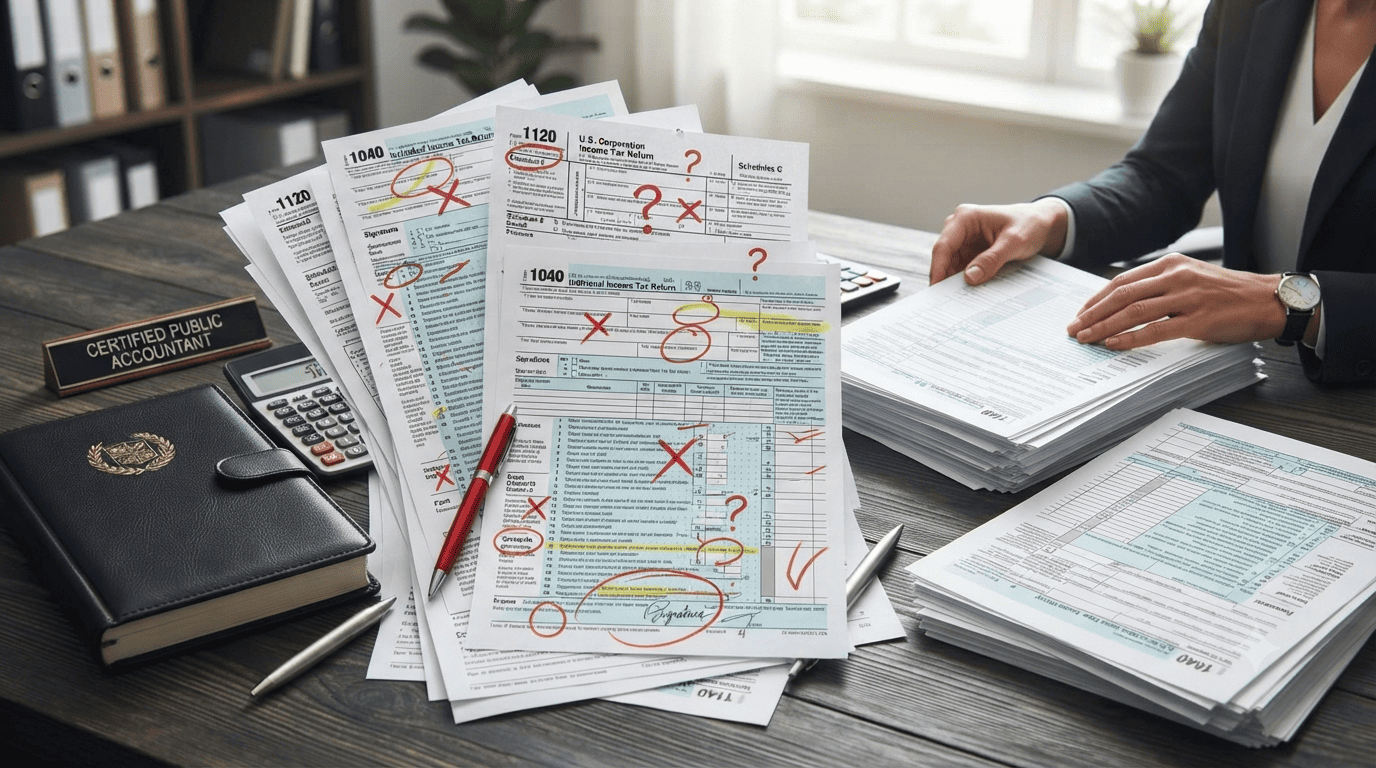
Running a small business means wearing multiple hats. One moment you're closing a sale, the next you're approving payroll, negotiating with suppliers, or chasing unpaid invoices. With so many priorities competing for your attention, it's easy to think about taxes only when the filing deadline starts appearing on your calendar.
Unfortunately, that's exactly where many costly mistakes begin.
One of the biggest misconceptions among business owners is that US Tax Preparation starts a few weeks before filing a tax return. In reality, your tax return is simply the final chapter of a financial story that has been written throughout the year. Every invoice you issue, every business expense you incur, every payroll run you process, and every transaction you record ultimately shapes what gets reported to the IRS.
Whether your business files Form 1120 as a C Corporation, Form 1120S as an S Corporation, Form 1065 as a partnership, or Schedule C (Form 1040) as a sole proprietorship, one fact remains the same: the accuracy of your tax return depends entirely on the accuracy of your accounting records.
During every tax season, CPA firms spend thousands of hours fixing problems that could have been prevented months earlier. Missing reconciliations, incomplete documentation, payroll errors, misclassified expenses, and disorganized books often consume more time than the actual preparation of the tax return itself. Instead of identifying tax-saving opportunities, accountants are forced to clean up avoidable bookkeeping issues.
The good news?
Most of these problems are entirely preventable with good financial habits and timely professional guidance.
Let's look at five mistakes that experienced CPAs encounter repeatedly during US Tax Preparation, why they happen, and how you can avoid them before they become expensive.
Mistake #1. Treating Bookkeeping as a Year-End Task Instead of a Year-Round Responsibility
Imagine this.
It's the first week of March, and your CPA emails asking for your accounting records. Confidently, you export your QuickBooks file and send it over.
A day later, your phone rings.
Your accountant has identified unreconciled bank accounts, duplicate income entries, missing vendor bills, uncategorized credit card transactions, and several deposits that don't match your bank statements. What you believed would be a straightforward tax engagement has suddenly become a bookkeeping cleanup project.
This situation is far more common than most business owners realize.
Many entrepreneurs focus on growing their business during the year and postpone bookkeeping until tax season arrives. While that approach may seem harmless, it often creates a ripple effect across your entire tax return.
For example, unreconciled books can affect:
- Business income reported on Form 1120, Form 1120S, or Form 1065
- Cost of Goods Sold calculations
- Depreciation schedules reported on Form 4562
- Shareholder or partner capital accounts
- Estimated taxable income
- Financial statements used for tax planning
By the time your CPA begins preparing the return, they first need confidence that the accounting records are accurate. If the underlying numbers cannot be trusted, every subsequent calculation becomes questionable.
Think of bookkeeping as building the foundation of a house.
No matter how skilled the architect may be, a strong roof cannot compensate for a weak foundation. The same principle applies to tax preparation. A technically perfect tax return prepared from inaccurate accounting records will still produce unreliable results.
The solution is surprisingly simple.
Instead of viewing bookkeeping as an annual obligation, treat it as a monthly business process.
- Reconcile bank accounts.
- Review credit card transactions.
- Match customer payments.
- Record vendor invoices.
- Investigate unusual balances.
These activities usually take only a few hours each month but save days of corrective work later.
Modern accounting platforms such as QuickBooks Online also make monthly reconciliations faster through automated bank feeds and transaction matching. However, automation should never replace professional review. Software records transactions. Experienced accountants interpret them correctly.
CPA Insight
One of the first things CPA firms evaluate before beginning US Tax Preparation is the quality of the bookkeeping. Clean, reconciled books allow tax professionals to focus on strategic planning, identifying deductions, and reviewing compliance instead of spending valuable time correcting avoidable accounting errors.
Mistake #2. Mixing Personal and Business Expenses - The Mistake That Creates More Work Than You Think
Picture yourself reviewing your business credit card statement.
You notice software subscriptions.
Office rent.
Marketing expenses.
Business travel.
Everything looks fine until you suddenly come across grocery shopping, your family's weekend vacation, a streaming subscription, and dinner at your favorite restaurant.
Individually, these transactions may seem insignificant.
Collectively, they create one of the most frustrating challenges during US Tax Preparation.
Every personal expense incorrectly recorded in the business books must be identified, investigated, documented, and removed before your CPA can confidently prepare the return. What could have been a two-hour review quickly turns into an eight-hour cleanup exercise.
Besides increasing accounting costs, mixed expenses create another risk.
The IRS expects businesses to maintain adequate documentation supporting every deduction claimed on a tax return. If personal purchases remain buried within business accounts, distinguishing legitimate business deductions becomes significantly more difficult.
For sole proprietors filing Schedule C (Form 1040), this often leads to overstated business expenses or deductions that cannot be adequately substantiated.
For corporations filing Form 1120 or Form 1120S, shareholder personal expenses may require additional accounting adjustments before the return can be finalized.
Even depreciation claimed through Form 4562 may become inaccurate if personal assets are incorrectly capitalized as business property.
Fortunately, preventing this problem is straightforward.
- Maintain dedicated business bank accounts.
- Use separate business credit cards.
- Avoid paying personal expenses directly from business accounts whenever possible.
- If an accidental transaction does occur, record it correctly immediately rather than waiting until year-end.
Small habits like these dramatically improve bookkeeping accuracy throughout the year.
More importantly, they allow your CPA to spend time where it truly matters, reviewing tax positions, identifying deductions, and providing strategic planning instead of separating grocery bills from office supplies.
CPA Insight
During busy season, many CPA firms estimate that bookkeeping cleanup consumes more time than preparing the actual tax return. Businesses with clean financial records often complete tax engagements faster, incur lower professional fees, and experience fewer post-filing adjustments.
Mistake #3. Misclassifying Workers Can Trigger Payroll Tax Problems You Never Expected
Hiring your first employee is exciting.
Hiring your tenth employee feels like growth.
Hiring independent contractors instead of employees often feels easier.
Unfortunately, what feels easier isn't always what the IRS considers correct.
Worker classification remains one of the most misunderstood areas of business taxation.
Many business owners assume they can simply choose whether someone receives a Form W-2 or a Form 1099-NEC. In reality, classification depends on the actual working relationship, not personal preference.
The IRS evaluates several factors, including:
- Who controls how the work is performed?
- Who provides equipment and tools?
- Can the worker offer similar services to multiple clients?
- Does the business determine working hours?
- Is the relationship ongoing or project-based?
These questions determine whether the worker is legally an employee or an independent contractor.
The distinction matters because the tax consequences are substantial.
Employees require payroll tax withholding, Social Security and Medicare contributions, federal unemployment tax reporting through Form 940, quarterly payroll reporting using Form 941, and annual wage reporting through Form W-2.
Independent contractors, on the other hand, are generally reported using Form 1099-NEC, with different withholding and reporting requirements.
Misclassification may result in unpaid payroll taxes, interest, penalties, amended payroll filings, and significant administrative effort to correct prior reporting.
This issue has become even more important as remote work and freelance hiring continue to grow. Startups, technology companies, marketing agencies, consulting firms, and e-commerce businesses frequently engage contractors across multiple states without fully understanding the associated compliance obligations.
That is why experienced CPAs encourage businesses to evaluate worker classification before onboarding new personnel, not after receiving an IRS notice.
A short conversation before hiring can prevent months of corrective filings later.
CPA Insight
Payroll compliance extends far beyond issuing paychecks. Proper worker classification affects payroll tax deposits, Forms 941, 940, W-2, and 1099-NEC, making it one of the most important compliance areas for growing businesses. Addressing classification questions early is significantly less expensive than correcting them after an IRS review.
Mistake #4. Chasing Tax Deductions at Year-End Instead of Documenting Them Throughout the Year
Every business owner loves the idea of paying less tax.
The problem is that many businesses focus on finding deductions only after the financial year has ended. By then, valuable opportunities may already be lost.
Imagine buying a new laptop for your office in January, subscribing to accounting software in March, attending an industry conference in June, purchasing machinery in August, and replacing office furniture in November.
Twelve months later, your CPA asks for supporting invoices.
You spend hours searching through emails, downloading duplicate invoices, calling vendors for copies, and trying to remember why certain purchases were made. Some receipts cannot be found. Others are incomplete. A few expenses were never recorded correctly in the books.
Now your CPA faces a difficult situation. Even though the business expenses may be genuine, every deduction claimed on a tax return should be supported by proper documentation. Without adequate records, claiming deductions becomes riskier, especially if the IRS requests additional information during an examination.
This is where proactive recordkeeping makes a remarkable difference.
Good documentation does more than support deductions. It also gives your CPA confidence when preparing your return and helps reduce unnecessary review questions.
Many businesses also overlook tax-saving opportunities because they simply are not aware they exist.
For example, qualifying businesses may be eligible to expense certain fixed asset purchases under Section 179, rather than depreciating them over several years. Depending on the applicable tax rules for the year, bonus depreciation may also be available for qualifying assets.
Likewise, businesses often forget to review whether they qualify for the Qualified Business Income (QBI) Deduction under Section 199A, which may significantly reduce taxable income for eligible pass-through entities.
Depreciation deductions reported through Form 4562 also depend on maintaining accurate fixed asset records, purchase dates, business use percentages, and supporting invoices.
The lesson is simple.
Tax deductions are rarely discovered during tax season.
They are created by maintaining organized financial records throughout the year.
When documentation is complete, your CPA spends less time requesting missing information and more time identifying legitimate tax-saving opportunities.
CPA Insight
Experienced CPA firms don't measure success by the number of deductions claimed. They measure success by how well every deduction can be supported if questioned by the IRS. Strong documentation is often just as valuable as the deduction itself.
Mistake #5. Waiting Until Tax Season to Speak with Your CPA
Perhaps the most expensive tax mistake isn't a bookkeeping error.
It isn't payroll.
It isn't missing receipts.
It's waiting until tax season to ask for tax advice.
Many business owners believe their CPA's job begins after the financial year has ended.
In reality, that's when many planning opportunities have already disappeared.
Imagine two identical businesses generating similar profits.
The first owner contacts their CPA only after year-end.
The second schedules quarterly meetings throughout the year.
Who do you think has more opportunities to legally reduce their tax liability?
The answer is almost always the second business.
Tax preparation is primarily about reporting history.
Tax planning is about shaping the future.
By the time your accountant begins preparing Form 1120, Form 1120S, Form 1065, or Schedule C, many important decisions have already been made.
Equipment has already been purchased.
Owner distributions have already been taken.
Payroll has already been processed.
Estimated tax deadlines may already have passed.
Certain elections may no longer be available.
Opportunities that could have reduced taxable income are now simply part of history.
Regular conversations with your CPA allow these decisions to happen before deadlines, not after them.
For example, proactive planning can help businesses:
- Review quarterly estimated tax payments using Form 1040-ES or Form 1120-W
- Evaluate whether equipment purchases should be accelerated before year-end
- Structure shareholder compensation more efficiently
- Plan retirement contributions
- Monitor cash flow before making major tax elections
- Review entity structure as the business grows
- Identify state tax obligations created through expanding operations
These discussions rarely happen during the final week before filing.
They happen months earlier.
One of the biggest differences between successful businesses and struggling businesses isn't simply revenue.
It's planning.
The businesses that consistently stay ahead of tax deadlines usually treat their CPA as a year-round advisor rather than someone who files returns once a year.
That mindset transforms US Tax Preparation from a stressful compliance exercise into a strategic business process.
CPA Insight
The greatest tax savings rarely come from preparing the return itself. They come from decisions made throughout the year. By the time your return reaches final review, most planning opportunities have already passed.
Final Thoughts
Preparing a business tax return is about far more than meeting an IRS deadline.
Whether your business files Form 1120, Form 1120S, Form 1065, or Schedule C (Form 1040), the quality of your tax return is directly influenced by the quality of your bookkeeping, payroll records, documentation, reconciliations, and financial planning.
The five mistakes discussed in this article appear repeatedly across businesses of every size. Fortunately, they also happen to be among the easiest problems to prevent.
- Keeping accurate books.
- Separating personal and business finances.
- Classifying workers correctly.
- Maintaining complete documentation.
- Speaking with your CPA before, not during tax season.
These simple practices not only reduce compliance risks but also allow your CPA to focus on what truly creates value: strategic tax planning, identifying legitimate deductions, and helping your business make informed financial decisions.
Think of your tax return as the final exam.
The preparation happens all year.
Need Reliable Support with US Tax Preparation?
At Grevx Consulting, we believe great tax returns begin with great accounting.
Our professionals support businesses and CPA firms with reliable, process-driven accounting and tax solutions designed to improve accuracy, efficiency, and compliance throughout the year.
Our capabilities include:
- US bookkeeping and month-end close
- Bank and credit card reconciliations
- Tax-ready financial statements
- Payroll accounting support
- Tax workpaper preparation
- Support for Forms 1040, 1040-NR, 1065, 1120, 1120S, and 990
- QuickBooks Online and cloud accounting support
- Financial statement preparation
- Offshore accounting and tax support for US CPA firms
Whether you're a growing business looking for organized financial records or a CPA firm seeking a dependable offshore accounting partner during busy season, our team works as a seamless extension of yours, delivering technical accuracy, timely turnaround, and complete confidentiality.
Because successful US Tax Preparation isn't built in the weeks before filing.
It's built through disciplined accounting, proactive planning, and the right professionals working beside you every step of the way.
Need help applying this insight?
Our consulting team helps businesses translate strategy into practical action.
Talk to our team →