

Picture a founder three weeks from closing a Series A.
The term sheet is signed. Then the investor's lawyers send the due-diligence questionnaire, and section 7 is titled "Data Protection".
Where do you store customer personal data? Who can access it? Show us your privacy notice and consent records. Which vendors process personal data on your behalf? Describe your last data breach drill.
The honest answers: in the CRM, in four Google Sheets, in the sales team's WhatsApp groups, and on a laptop that left with an employee in March. Everyone can access it. There is a privacy policy, copied from a competitor in 2023. Nobody has ever run a breach drill.
None of this would have mattered much two years ago. It matters now.
One year in, six months to go
India's Digital Personal Data Protection Rules were notified on 13 November 2025. Tomorrow, exactly one year later, the second milestone arrives. Six months after that — on 13 May 2027 — the obligations that carry penalties of up to ₹250 crore per instance come into force.
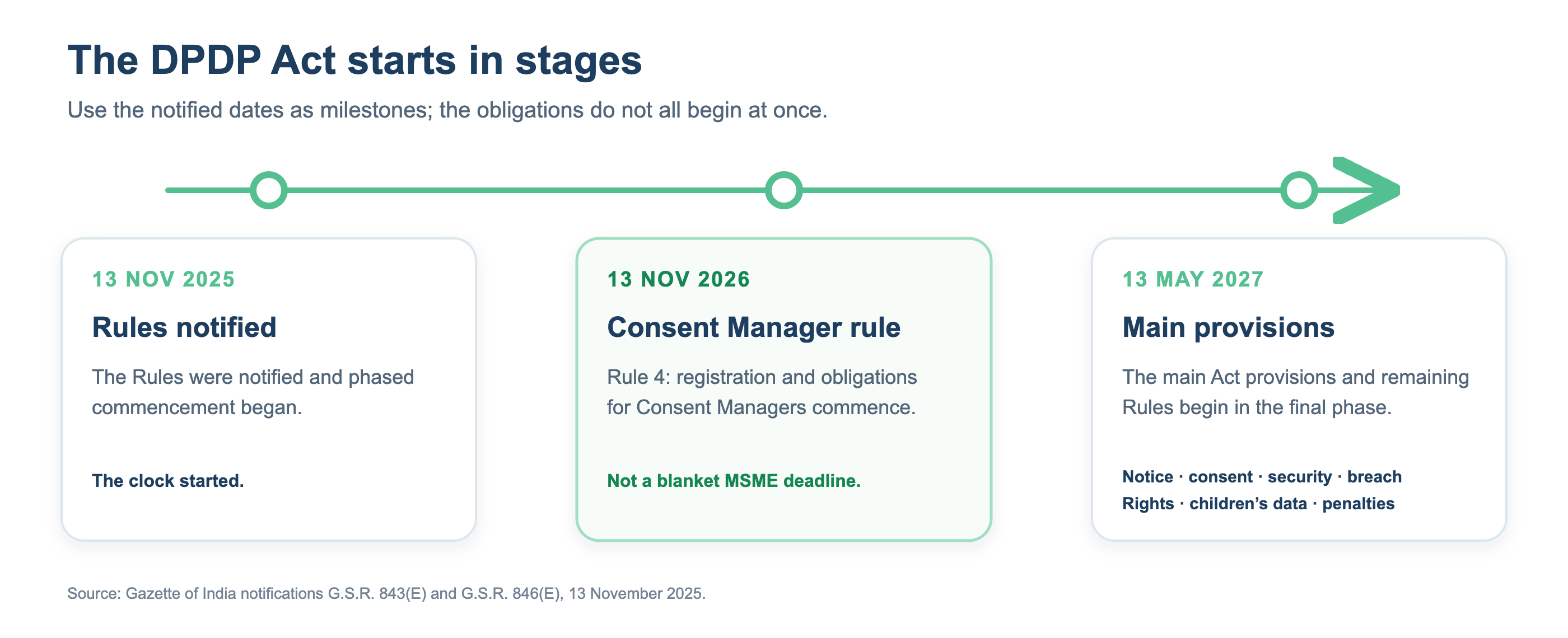
In January 2026, reports said the government was considering shortening the runway to 12 months. As of October, nothing had been notified and 13 May 2027 remains the date. But the direction of travel is clear: the window is not getting longer.
Where personal data hides in a typical business
Most founders think of personal data as "our customer database". In practice, it sits in far more places:
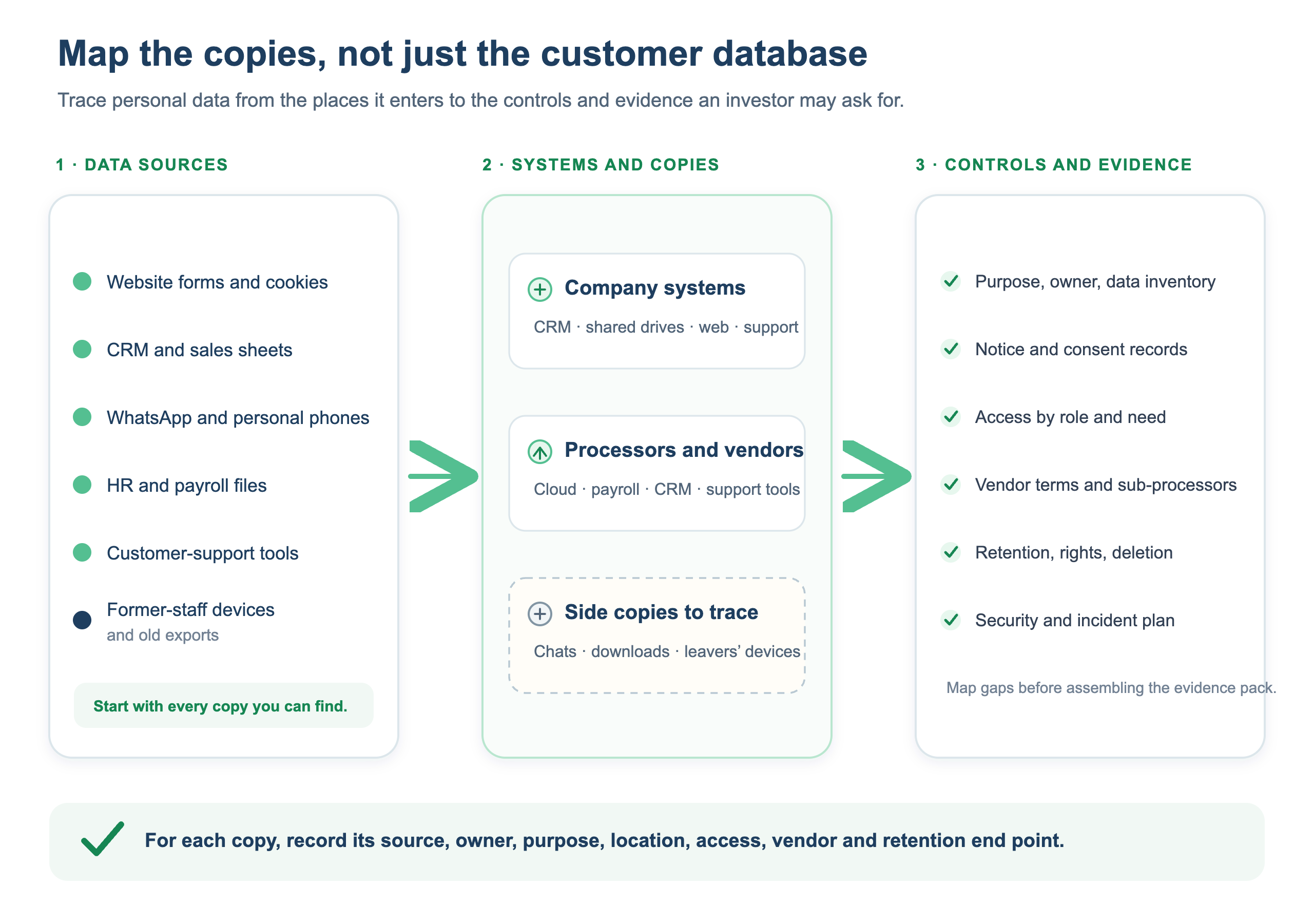
If even three of these sources apply to your business, you have a data map to build.
Why this is a fundraising issue, not just a legal one
Due-diligence teams follow regulation. Once a law with a nine-figure penalty is live, data protection becomes a standard section of the questionnaire, alongside tax, labour and contracts.
A gap found in diligence rarely kills a deal. It does something more expensive: it becomes a special indemnity, a condition before money is released, or a discussion about valuation. We wrote earlier about how businesses can be fully tax compliant and still be one inspection away from trouble. Data protection is the newest item on that list.
B2B companies feel this from the other side too. Large customers remain accountable for what their vendors do with personal data, and they will push those obligations into your contracts.
Three myths that will cost founders
"We're B2B, we don't hold personal data." Your CRM holds names, emails and phone numbers of real people. Your payroll holds employee data. Both count. So do paper forms you later scan.
"We're a startup, we'll be exempt." The Act lets the government exempt notified startups from a few provisions: notice, data accuracy and erasure, and the right to access information. No such notification exists today. Even if one comes, it does not cover security safeguards or breach reporting.
"Our cloud vendor handles compliance." The business that decides why and how data is used stays responsible, even when a vendor does the processing.
The six-month playbook
| Month | Workstream | Done when |
|---|---|---|
| Nov–Dec 2026 | Data map: every system, form and sheet holding personal data, with owner, purpose and retention period | One register covers every source in the map above |
| Jan 2027 | Notice and consent: plain-language standalone notice; withdrawing consent as easy as giving it | Consent is logged and retrievable per person |
| Feb 2027 | Vendor sweep: processor agreements, sub-processors, where data is stored | Every vendor touching personal data has signed terms |
| Mar 2027 | Security and breach drill: access controls, encryption, logs, a tested incident plan | One breach simulation run and documented |
| Apr 2027 | Rights and grievances: access, correction and erasure requests; published grievance contact; deletion schedule | Requests can be closed within the prescribed time |
| May 2027 | Board sign-off and evidence pack | The data-room folder is ready before anyone asks |
The ten-minute self-check
Answer these honestly:
- Could you list every place your business stores personal data, today, without asking anyone?
- Could you show when and how a specific customer consented to hearing from you?
- If an employee left today, would you know which customer data was on their laptop or phone?
- Does every vendor that touches personal data have a signed agreement covering it?
- If you discovered a breach tonight, who would you call first, and is that written down?
Two or more "no" answers mean the work should start this month, not in April.
Five documents your data room should hold by May 2027
- A data inventory: what you collect, why, where it sits and for how long.
- Your privacy notice and the consent logs behind it.
- A register of vendor and processor agreements.
- An information security policy, with evidence it is followed.
- A breach response plan and the record of your last drill.
How Grevx helps
Startup compliance and investor readiness is a core Grevx Consulting practice. We build the data map, put the evidence pack together and work alongside your legal counsel, so the compliance work doubles as diligence-ready documentation.
Six months is enough if you start this month. It is not enough if you start in April. Talk to us.
FAQs
Does the DPDP Act apply to small businesses and MSMEs? Yes. It applies to any business processing digital personal data of individuals in India, whatever its size.
What is the maximum DPDP penalty? Up to ₹250 crore per instance, for failing to take reasonable security safeguards against a data breach. Other breaches carry lower caps.
What changes on 13 November 2026? The framework for registering Consent Managers comes into force. Most businesses do not need to register as one; the substantive duties begin on 13 May 2027.
This post is general information, not legal advice. Sources: Mondaq / King Stubb & Kasiva, Aug 2026; DPDP Wiki on Section 17; dpdprules.org on the 12-month proposal.
Need help applying this insight?
Our consulting team helps businesses translate strategy into practical action.
Talk to our team →