
Picture the last week of March 2027.
The tax auditor sends the CFO a list: 38 suppliers, ₹2 crore of bills, all unpaid for more than 45 days. Every one of them is a micro or small enterprise.
"No problem," says the CFO. "We'll clear them in April, well before the return is due."
"That won't help," says the auditor.
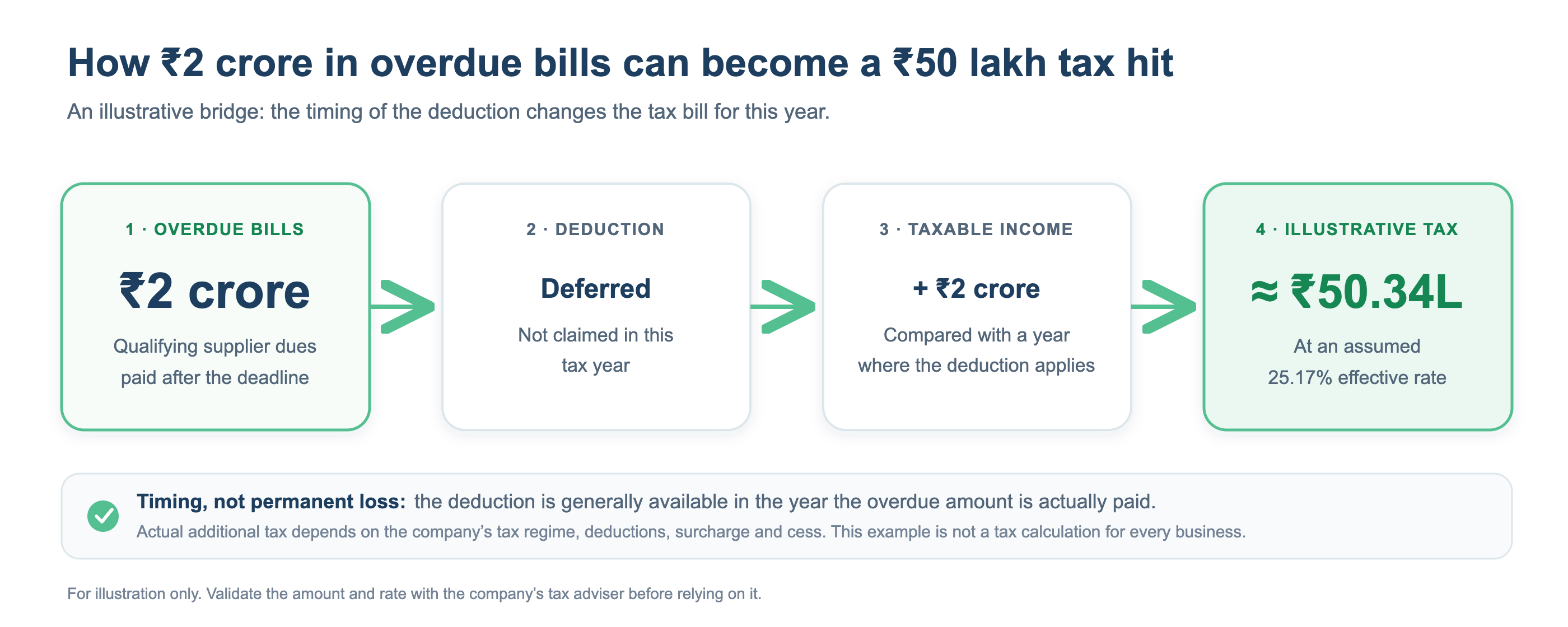
That ₹2 crore has just added roughly ₹50 lakh to this year's tax bill. Not a penalty. Just a deduction pushed into next year, with the cash leaving now.
This is the rule most finance teams knew as Section 43B(h). It has a new address, more suppliers fall under it than last year, and the suppliers themselves now have sharper teeth.
What changed, and what did not
The Income-tax Act, 2025 came into force on 1 April 2026. The MSE payment rule carries over as Section 37(2)(g), replacing Section 43B(h) of the 1961 Act. FY 2025-26 is still assessed under the old section; Tax Year 2026-27 is the first under the new one.
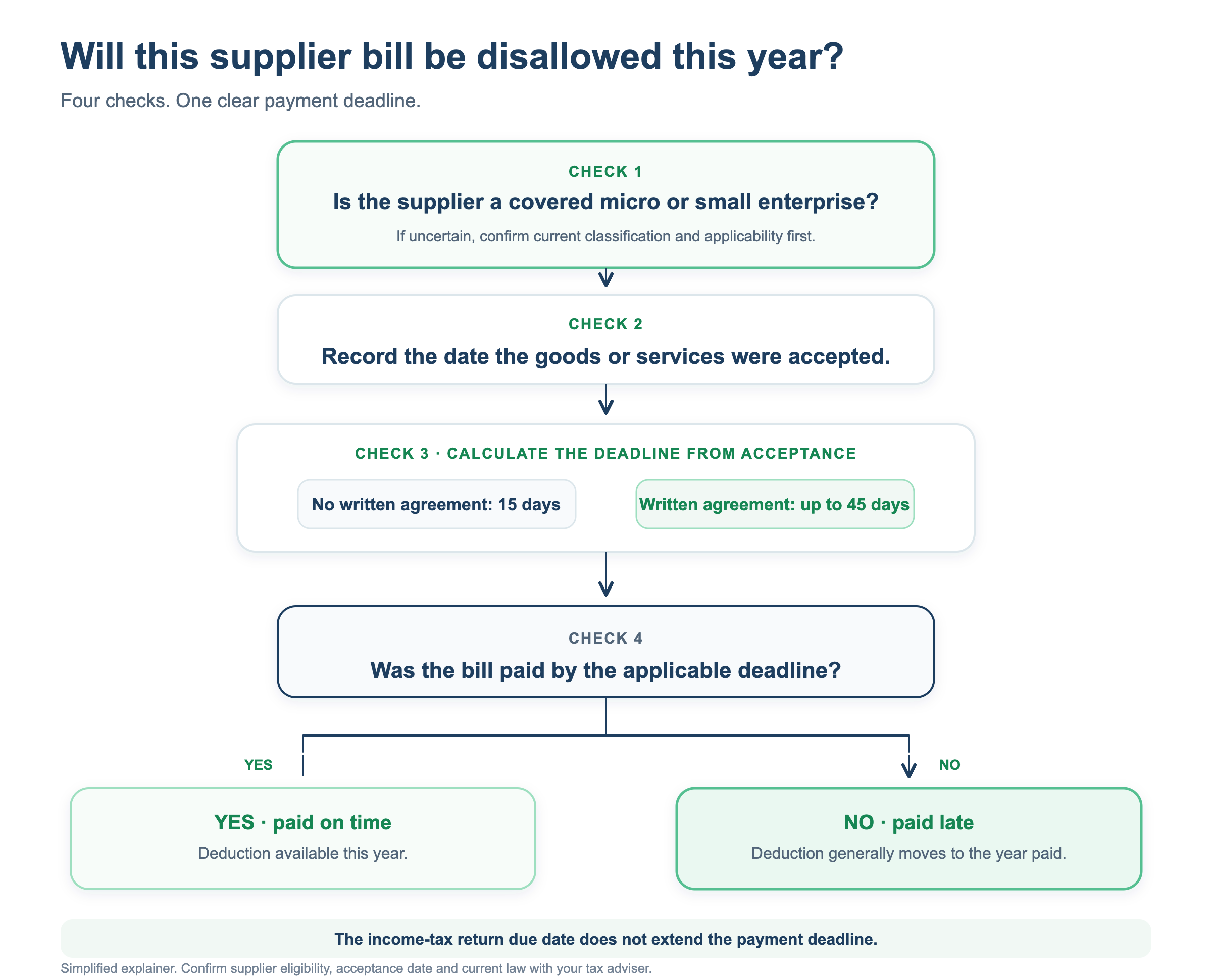
The substance is unchanged. A sum owed to a micro or small enterprise is deductible in the year it accrues only if it is paid within the time limit in Section 15 of the MSMED Act. Otherwise, the deduction waits until the year you actually pay.
That time limit is 15 days from acceptance where there is no written agreement. With a written agreement, it is the agreed period — but never more than 45 days.
The first year-end under the new section is 31 March 2027, about four and a half months away.
The detail most finance teams miss: more of your suppliers are now "small"
From 1 April 2025, the MSME classification limits were raised. Classification uses both tests together: investment in plant, machinery or equipment, and turnover.
| Category | Old limit (investment / turnover) | Revised from 1 Apr 2025 |
|---|---|---|
| Micro | ₹1 crore / ₹5 crore | ₹2.5 crore / ₹10 crore |
| Small | ₹10 crore / ₹50 crore | ₹25 crore / ₹100 crore |
| Medium | ₹50 crore / ₹250 crore | ₹125 crore / ₹500 crore |
Take a supplier with ₹80 crore turnover and ₹20 crore of plant and machinery. Under the old limits, it was medium and outside the rule. Today it is small, and every invoice you owe it is in scope.
If your vendor master was tagged in 2024, it is out of date. Medium enterprises remain outside the rule. So do traders: their Udyam registration does not carry the MSMED Act payment protection.
What it costs: the full bill
Say your company pays tax under the 22% concessional regime, about 25.17% effective. At 31 March 2027, you owe ₹2 crore to small suppliers beyond the 45-day window.
- Tax: the ₹2 crore is disallowed for Tax Year 2026-27, adding roughly ₹50 lakh to this year's tax. You get the deduction back in the year you pay, but the cash leaves now.
- Interest to the supplier: the MSMED Act entitles the supplier to compound interest at three times the RBI bank rate, with monthly rests.
- Interest you cannot deduct: that interest is not an allowable expense for tax.
- Disclosure: companies must report MSE dues outstanding beyond 45 days in Form MSME-1 every half-year, and the tax auditor reports the disallowance.
The trap: the return due date will not save you
For most Section 43B-type expenses, paying before the return due date rescues the deduction. Not this one.
An invoice accepted on 1 March and paid on 10 April is inside its 45-day window, so it stays deductible in the year of purchase. The same invoice paid on 25 April loses the deduction for that year, even though the return is months away. The clock that matters is the MSMED clock.
New in 2026: small suppliers can now push back harder
Parliament passed the MSMED (Amendment) Act in August 2026. As its provisions are notified, the balance shifts further towards the supplier:
- Faster disputes. Facilitation Councils must complete mediation within 90 days, and an arbitral award must follow within 90 days of pleadings.
- Real recovery. A mediated settlement or award can be recovered as arrears of land revenue, by the authority where the buyer's assets sit.
- Less room to stall. A buyer challenging an award still deposits 75% of it, and courts can release at least half to the supplier if the challenge drags past six months.
- Penalties for hiding dues. Buyers who fail to disclose unpaid MSE dues face a warning, then a penalty of ₹10,000 to ₹50,000, then a fine of up to ₹1 lakh.
- TReDS for PSUs. Central public sector enterprises must settle MSME invoices through TReDS.
Put together: paying late now costs you tax, interest, possible penalties and a supplier with a much stronger hand.
Your 31 March 2027 playbook
- Re-tag the vendor master this month. Capture the Udyam number, category (micro, small or medium), activity (manufacturing, services or trading) and the date you verified it.
- Fix the paperwork. Put payment terms of 45 days or less in writing. Without a written agreement, the clock is 15 days.
- Track acceptance, not invoice date. The clock runs from acceptance or deemed acceptance. Your GRN or acceptance date must be a system field.
- Run a weekly MSE ageing report. Buckets of 0–15, 16–30, 31–45 and over 45 days, reviewed by finance every week.
- Clear the backlog in January and February. Prioritise the oldest MSE dues. Use TReDS where funding is tight.
- Run March on a daily dashboard. Document every disputed invoice so the acceptance position is clear.
- Reconcile in April. Tie the numbers out for the tax audit and the Form MSME-1 return due by 30 April.
Steps 3 and 4 are where most businesses fail, because the data sits in purchase, stores and accounts separately. It is also why MSE dues deserve a line on the owner's Monday page we wrote about earlier this week.
If you are the micro or small supplier
This rule is leverage. Update your Udyam registration to reflect your current category. Put 45-day terms in every purchase order, and reference the rule politely in your payment reminders. If a buyer still does not pay, the MSME Samadhaan portal and your State's Facilitation Council now move faster than they used to.
How Grevx helps
Accounting and tax advisory is a core Grevx Consulting practice. We re-tag vendor masters, set up MSE ageing and acceptance tracking inside your accounting system, and run the year-end review before your auditor does.
The cheapest time to fix this is November. The most expensive is the last week of March. Talk to us.
FAQs
Has Section 43B(h) been removed under the Income-tax Act, 2025? No. It continues as Section 37(2)(g) from Tax Year 2026-27.
Does the rule apply to payments to medium enterprises or traders? No. It covers only micro and small enterprises, and traders do not get the MSMED Act payment protection.
Does paying before the ITR due date protect the deduction? No. The payment must fall within the MSMED Act limit of 15 days, or the agreed period capped at 45 days. If it doesn't, the deduction moves to the year of payment.
What did the MSMED Amendment Act 2026 change? It speeds up dispute resolution, allows awards to be recovered as arrears of land revenue, adds penalties for buyers who hide unpaid dues, and requires central PSUs to settle MSME invoices through TReDS. Provisions take effect as the government notifies them.
General information, not tax advice; confirm positions with your tax advisor. Sources: Busy — Section 37(2)(g) mapping; Taxmann — revised MSME limits; PIB — MSMED (Amendment) Bill, 2026; Bar & Bench — MSMED Amendment Act 2026.
Need help applying this insight?
Our consulting team helps businesses translate strategy into practical action.
Talk to our team →