

Imagine a board pack says the company is winning: Revenue is up 30%. The bank balance says something else.
The CEO asks the finance team, “Which sales are using cash before they bring it in?”
That is a better question than “Why is the forecast wrong?”
Revenue and cash are not rival versions of performance. One records sales; the other records when money actually moves. A fast-growing business can report more sales and still need more cash to fund invoices, stock, delivery, and the gap before customers pay.
Consider this illustrative operating snapshot. Receivables take 45 days to turn into cash, inventory sits for 52 days, and suppliers are paid in 35 days. The cash conversion cycle is 62 days: 45 + 52 − 35. A few months later, the same measures are 68, 64, and 38 days. The cycle is now 94 days. The business must finance 32 extra days between paying for operations and collecting from customers.
First, read the cash conversion cycle
For businesses with inventory, a useful starting point is:
Cash conversion cycle = receivable days + inventory days − payable days.
It is a diagnostic, not a scorecard. Compare the business with its own history, season, product mix, and agreed supplier terms. A longer cycle does not automatically mean poor management; a shorter one is not worth pursuing if it damages service or supplier reliability. The CFA Institute’s explanation of the cash conversion cycle sets out the same relationship.
For a service business with little or no inventory, the formula needs adapting; do not force a manufacturing metric onto a different model. Even for inventory-led companies, use consistent periods and averages. A single month-end balance can swing with seasonality, a large shipment, or a payment run, so pair the days metric with the underlying rupee balances and the dates cash is expected to move.
Four readings that explain the gap
1. Receivable days: did the sale become a collectible invoice?
Use average trade receivables divided by credit sales per day as a directional days-sales-outstanding measure. Then split it by customer, invoice age, and billing milestone. If the average rises, ask where the delay begins: work completed but not billed, invoices waiting for approval, disputed amounts, or customers paying beyond agreed terms. Give each material delay an owner and next action. Chasing every customer equally is rarely the best use of a team’s time.
2. Inventory days: what is the business funding before it can sell?
Compare average inventory with cost of goods sold per day, then separate fast-moving, slow-moving, and committed stock. A rising average may reflect a deliberate service buffer—or purchases made ahead of demand, long lead times, minimum order quantities, or products that are no longer moving. Ask which inventory protects a specific customer promise and which is simply occupying working capital.
3. Payable days: when does cash leave, and what is the trade-off?
Compare supplier payment timing with contractual terms and the actual payment calendar. Early payment may be sensible when it earns a real discount; late payment may risk supply or trust. The objective is a deliberate schedule that matches receipts and operating needs, not the maximum possible delay. Do not fund a structural cash gap by quietly pushing suppliers past agreed terms.
4. Contribution margin: did the extra revenue bring sound economics?
Look at contribution by product, customer, and channel after the variable costs required to win and serve the sale. Include discounts, freight, commissions, returns, and service effort where relevant. If contribution has weakened, faster collections alone will not fix the economics. If margin is sound but invoices are slow, the response is different: address billing, milestones, or credit terms before changing the product strategy.
Turn the diagnosis into a leadership decision
Put the four readings beside their prior-period trend, the cash consequence, a named owner, and the decision needed. Add a rolling 13-week view of expected receipts and committed payments so leaders can see when pressure arrives, not just that cash is lower at month-end.
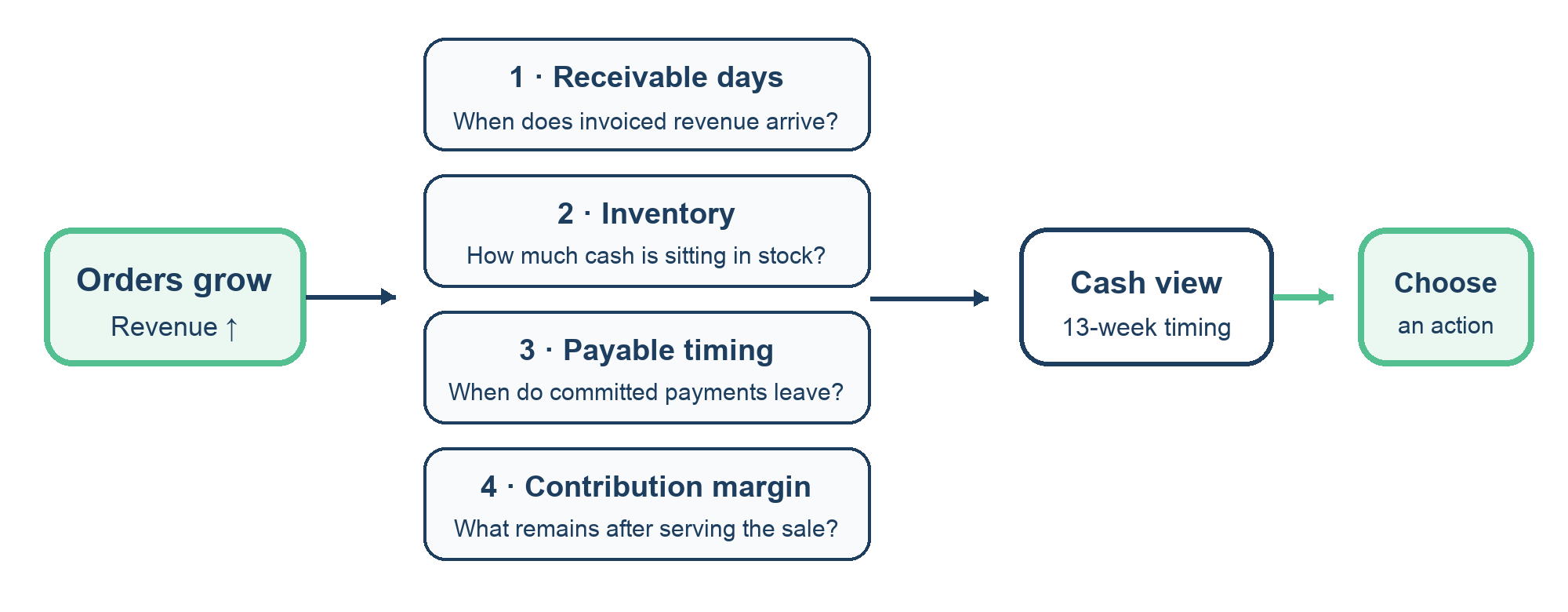
Then ask which pattern the evidence supports:
- Timing problem: margins hold, but collection or inventory days rise. Fix the billing, collection, purchasing, or milestone bottleneck.
- Economics problem: contribution falls on the new sales. Revisit price, discounting, fulfilment cost, or customer mix.
- Both: growth is consuming cash and earning less. Slow or reshape the growth until the economics and funding cycle are visible.
At the next review, do not ask finance to “watch cash more closely.” Ask for the largest driver of the cycle change, the action owner, the expected effect, and the date the team will check whether it worked. That turns a worrying bank balance into an operating decision.
For more on the finance systems behind this work, see Grevx’s Accounting & Compliance services and our cash-flow due-diligence guide.
Need help applying this insight?
Our consulting team helps businesses translate strategy into practical action.
Talk to our team →